
We've all grabbed a vitamin C supplement off a shelf without thinking too hard about it. A big bottle, a familiar brand, decent price per count. Done.
The problem is that "vitamin C" on a label can mean several different things — plain ascorbic acid, buffered calcium ascorbate, whole-food complexes with bioflavonoids, or forms specifically studied for leukocyte uptake. They're not interchangeable.
Your immune cells accumulate vitamin C at concentrations 50 to 100 times higher than plasma, and the form you take affects how efficiently that uptake happens.
There's also a collagen angle that doesn't get enough attention. Vitamin C acts as a cofactor for the enzymes that hydroxylate proline and lysine — the step that stabilizes collagen's triple-helix structure.
Without adequate vitamin C, the collagen your body tries to synthesize is weaker. That matters if you're taking a separate collagen supplement or just trying to keep skin firm as collagen production slows with age.
We went through the research and the product labels to find picks that are actually differentiated — by form, dose, third-party testing, and cost-per-dose. We ranked seven options for adults looking for a daily maintenance supplement, not an emergency megadose. Here's what made the cut and why.
Editorial Disclaimer
This article is for informational purposes only and is not a substitute for professional medical advice. The Ritual Guide does not diagnose, treat, or cure any condition. Always consult your healthcare provider before starting any new supplement, especially if you're pregnant, nursing, taking medication, or managing a chronic condition.
Key Takeaways
- Vitamin C form matters: calcium ascorbate has shown higher leukocyte accumulation in some studies compared to plain ascorbic acid at equivalent doses.
- The Recommended Dietary Allowance (RDA) for adult women is 75mg/day; research on skin and collagen support tends to use doses of 500–1,000mg, which is where most of these supplements land.
- Third-party testing varies widely in this category — we flagged NSF certification, Good Manufacturing Practices (GMP) compliance, and published purity testing for each pick.
- Cost-per-dose on vitamin C can range from $0.07 to $0.40 per capsule — the gap is real, and the pricier options aren't always the better-absorbed ones.
- Sensitive stomachs should skip plain ascorbic acid — buffered forms and calcium ascorbate cause fewer GI issues at the same dose.
The 7 Best Vitamin C Supplements
Viva Naturals Vitamin C 1000mg with Bioflavonoids & Rose Hips
Best For: Daily maintenance with sourcing transparency

This is the pick if sourcing transparency matters to you. Viva Naturals uses Quali-C — ascorbic acid manufactured in Scotland, not the more common Chinese-sourced variety. It's a distinction that's hard to verify on most labels, but Viva Naturals is upfront about it.
Each capsule delivers 1,000mg vitamin C alongside citrus bioflavonoids and rose hips. The bioflavonoids are worth noting: one 1988 study found vitamin C paired with a natural citrus extract was absorbed 35% more efficiently than standalone ascorbic acid. Results across studies are mixed, but the combination is well-tolerated and adds antioxidant value on its own.
The formula is non-GMO, gluten-free, and vegetarian. Third-party tested per batch. At 250 capsules for $21.99, the per-dose cost lands at $0.09 — solid value for the sourcing story.
Why We Like It
Quali-C sourcing is the clearest supply chain signal in this category — it's the kind of detail that most brands quietly omit, and we appreciate that Viva Naturals leads with it.
Price
$21.99 for 250 capsules (check current pricing)
Nutricost Vitamin C with Rose Hips 1025mg
Best For: Value-first buyers who don't want to compromise on testing

Nutricost keeps things simple: 1,000mg ascorbic acid plus 25mg rose hips, one capsule per serving, manufactured in an NSF-certified, GMP-compliant, FDA-registered facility. That's a meaningful facility credential stack for a supplement at $0.07 per capsule.
The rose hips addition is a small but real bonus — rose hips are a natural vitamin C source that also bring a modest bioflavonoid profile. It's not the same as a dedicated bioflavonoid complex, but it's better than plain ascorbic acid with nothing else.
Non-GMO and gluten-free. The 240-count bottle at $17.95 makes this one of the lowest cost-per-dose picks in this guide. If you're taking it daily long-term, the math adds up.
Why We Like It
The facility credentials here — NSF-certified facility, GMP-compliant, FDA-registered — are the kind of third-party quality signals we look for when a product is priced this low.
Price
$17.95 for 240 capsules (check current pricing)
Nature Made Vitamin C 500mg
Best For: Lower-dose daily supplementation and first-time buyers

Nature Made's 500mg tablet is the most accessible entry point in this guide. Plain ascorbic acid, USP-verified, no artificial colors, no added preservatives. It's the "#1 Pharmacist Recommended" vitamin brand — a Nielsen-data claim, not marketing language.
The 500mg dose is worth considering for readers who are already getting some vitamin C from food and don't want to push toward the upper tolerable limit. The RDA for adult women is 75mg; research supporting skin and collagen benefits tends to use 500–1,000mg. This sits in the middle — a reasonable maintenance dose for most.
At $7.99 for 100 tablets, cost-per-dose is $0.08. Gluten-free, no color added. Straightforward and easy to find at any pharmacy.
Why We Like It
USP verification is meaningful quality assurance — it means the label dose is actually in the bottle and it'll dissolve as expected. For a category where quality varies, that matters even on a $7.99 purchase.
Price
$7.99 for 100 tablets (check current pricing)
Nature's Lab Gold Super Vitamin C 1000mg
Best For: Sensitive stomachs and readers who want a non-acidic form

Nature's Lab uses calcium ascorbate — a buffered form that's pH-neutral rather than acidic. If plain ascorbic acid causes heartburn or GI discomfort, this is where to start. A 2008 study found that people taking calcium ascorbate had higher vitamin C levels in their leukocytes (white blood cells) compared to those taking standard ascorbic acid at the same dose.
The formula also includes 200mg citrus bioflavonoids and 200mg quercetin per serving. Quercetin is a plant flavonoid with its own antioxidant properties and some preliminary research pointing to immune support. The combination makes this a more complex formula than most single-ingredient picks.
Vegetarian capsules, cGMP-certified facility, made in the USA. At $13.99 for 120 capsules (after an 18% discount), cost-per-dose is $0.12 — still reasonable for the added formula complexity.
Why We Like It
Calcium ascorbate plus quercetin in one capsule is a genuinely differentiated formula — the quercetin adds independent antioxidant value, not just absorption marketing.
Price
$13.99 for 120 capsules (check current pricing)
Alkaline for Life Alkalini-C Buffered Vitamin C 1000mg
Best For: Corn-free and citrus-free buyers with digestive sensitivity

Most commercial vitamin C starts from corn — a fact most brands don't advertise. Alkalini-C uses 100% L-ascorbate, a fully reduced and buffered form, and it's explicitly corn-free. That distinction matters for people with sensitivities, and it's verifiable: the ingredient list is fully disclosed inside the Supplement Facts panel with no "other ingredients" footnote.
The calcium it pairs with is calcium ascorbate (111mg per tabsule), not a filler form of calcium. The "tabsule" format — a pressed tablet in a capsule shape — avoids the powder-measuring inconvenience without gelatin. Directed by Dr. Susan Brown, PhD, a New York State Certified Nutritionist. Third-party purity tested per batch.
At $39.50 for 100 tabsules, this is the most expensive pick in the guide at $0.40/dose. You're paying for sourcing specificity and a genuinely clean label — it's a tradeoff worth naming.
Why We Like It
The full-disclosure label — every ingredient including excipients inside the Supplement Facts panel — is rare in this category. Most brands bury filler ingredients in a separate "other ingredients" line. Alkalini-C doesn't.
Price
$39.50 for 100 tabsules (check current pricing)
Optimal Health Systems Whole C Chewable
Best For: Whole-food vitamin C sourced from acerola, orange, and black currant
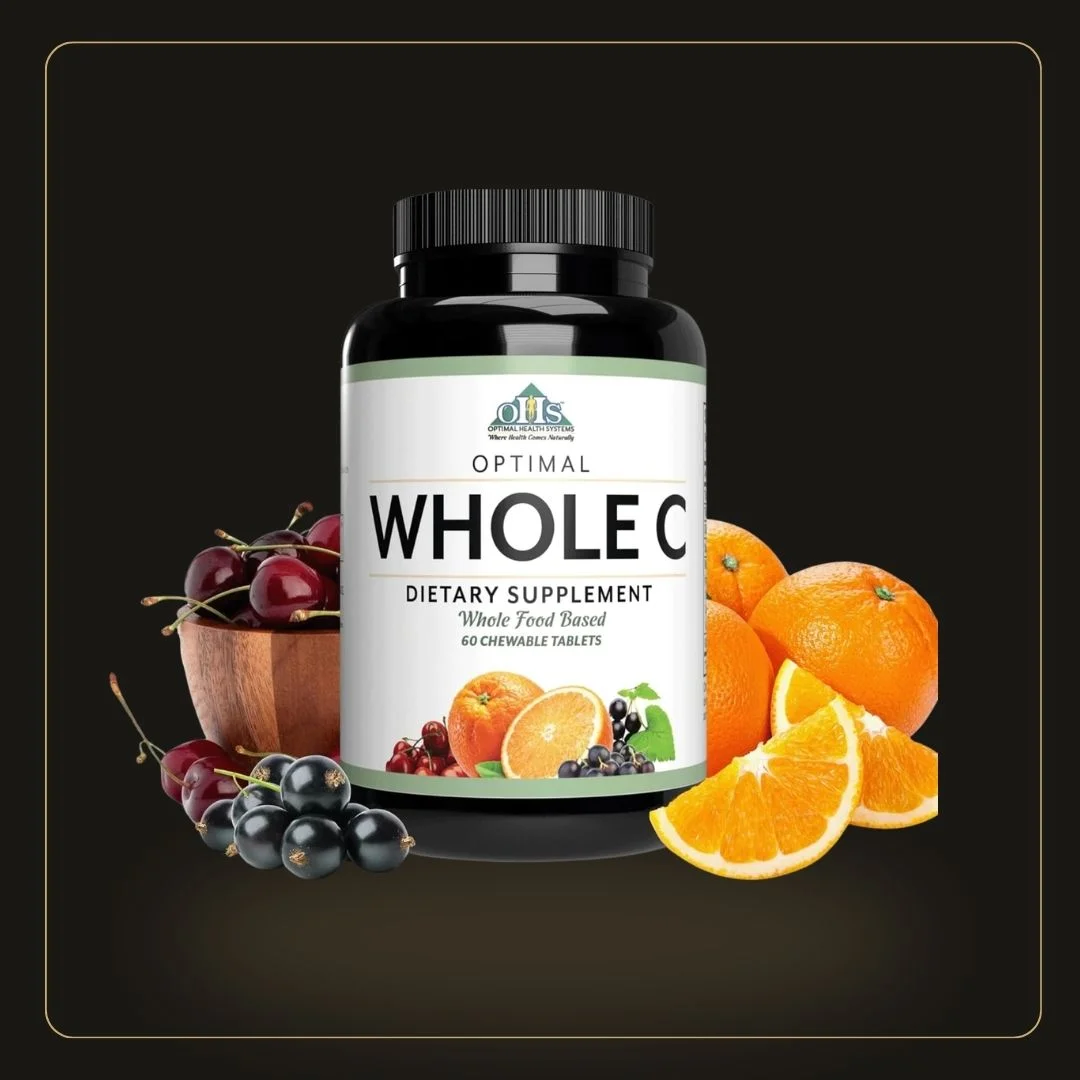
This is the pick for readers who want vitamin C as it appears in food — not isolated ascorbic acid, but the full complex: ascorbic acid, bioflavonoids, rutin, and what the brand calls J&K Factor (the cofactors present in whole fruit). Sources are acerola cherry, orange fruit, and black currant.
Acerola cherry is one of the most concentrated natural sources of vitamin C — roughly 65 times more than citrus per gram. The chewable format and plant-based sourcing make this one of the more enjoyable formats in the guide. Non-synthetic, dairy-free, gluten-free, non-GMO, GMP-certified.
The tradeoff: 60 tablets at $38.00 is $0.63 per tablet — by far the highest cost-per-dose here. This is a quality-first choice, not a value play. If cost is a factor, this isn't the pick.
Why We Like It
The whole-food sourcing from acerola, orange, and black currant is genuinely different from synthetic ascorbic acid — and the chewable format makes it easy to work into a morning routine without water.
Price
$38.00 for 60 chewable tablets (check current pricing)
Viva Naturals Vitamin C + Zinc 1000mg / 20mg
Best For: Immune-focused supplementation during cold and flu season

When immune support is the primary goal, pairing vitamin C with zinc is a logical stack. This Viva Naturals formula combines 1,000mg vitamin C (L-ascorbic acid, citrus bioflavonoids, rose hips) with 20mg zinc sulfate in one capsule. Zinc sulfate is more bioavailable than zinc oxide — a distinction that matters because most bargain zinc supplements use oxide.
The 250-count bottle works out to an 8-month supply at one capsule per day — a reasonable cadence for daily maintenance. Non-GMO verified, gluten-free, dairy-free, veggie capsules. GMP-certified facility.
One thing to keep in mind: this is not a standalone pick if your primary goal is collagen support or skin. The zinc adds immune value but the zinc dose is meaningful — 20mg is 182% of daily value, so check your other supplements for zinc overlap before stacking.
Why We Like It
Zinc sulfate over zinc oxide is the right call — and it's the kind of formulation decision that doesn't make it onto the front label. We noticed, and it's one reason this combination pick made the guide.
Price
$24.95 for 250 capsules (check current pricing)
How We Chose These Vitamin C Supplements
Product guides at The Ritual Guide are built around ingredient quality, formulation transparency, third-party testing, and real cost-per-dose math. For vitamin C specifically, we also factored in form — because the difference between plain ascorbic acid and buffered or whole-food forms isn't marketing language, it reflects real differences in how the vitamin behaves in the body.
Form and Bioavailability
Not all vitamin C supplements are built the same. Plain ascorbic acid is the most common and least expensive form. A 2025 systematic review in Nutrients found that buffered forms — particularly calcium ascorbate and calcium ascorbate with metabolites (sold as Ester-C) — showed improved leukocyte vitamin C concentrations compared to standard ascorbic acid in several studies.
Results varied by dose and study design, but the direction of evidence favors buffered forms for immune cell uptake.
Bioflavonoid combinations are popular but the absorption evidence is mixed. A widely cited 1988 study found 35% better absorption with vitamin C in a natural citrus extract, but most subsequent studies showed no measurable difference. The bioflavonoids do offer independent antioxidant value — it's just not the absorption multiplier some brands imply.
Third-Party Testing
We looked for products with NSF certification, USP verification, or documented cGMP compliance. These signal that what's on the label is in the bottle and that manufacturing follows quality controls. Not every product in this guide has the same level of certification, which is why we note it explicitly for each pick.
Cost-per-Dose
We calculated the per-capsule cost for every pick. The range in this guide runs from $0.07 (Nutricost) to $0.63 (Optimal Health Systems). Higher cost doesn't always mean better absorption — but it may mean cleaner sourcing, stricter testing, or a more complex formula. We named the tradeoff for each.
What We Left Out
The Vitamin World B-Complex with Vitamin C didn't make this guide — it's a B-complex supplement where vitamin C is one of several secondary ingredients, not a standalone vitamin C supplement. We also moved kids' and powder formats to dedicated sub-guides where they fit the format better.
How Vitamin C Fits Into Your Day
Timing matters more than most people think when it comes to vitamin C. It's water-soluble, which means your body doesn't store it the way it stores fat-soluble vitamins — you absorb what you need and excrete the rest. That has two practical implications.
First, taking your full daily dose in one large amount is less efficient than splitting doses. At 1,000mg taken at once, absorption starts to plateau; at 200mg, absorption is close to complete. If you're taking a 1,000mg capsule daily, that's fine — but splitting to 500mg twice daily would improve the amount your body actually retains.
Second, vitamin C may be more useful taken near meals that contain collagen protein or iron-rich foods. It acts as a cofactor for collagen synthesis enzymes, so pairing it with collagen powder, a protein-rich meal, or plant-based iron sources (where it markedly improves iron absorption) puts it to work.
The Ritual
Take 500mg vitamin C with breakfast — ideally a meal that includes protein or collagen.
Splitting the daily dose improves absorption; morning timing pairs well with collagen powder in coffee or smoothies.
Second 500mg dose with lunch, especially if the meal includes plant-based iron sources.
Vitamin C taken with non-heme iron (leafy greens, legumes) can markedly improve absorption — a useful angle for menstruating women.
Sensitive stomach? Switch to a buffered form (Nature's Lab Gold or Alkalini-C) before splitting doses.
Plain ascorbic acid on an empty stomach can cause GI discomfort, especially at 1,000mg. Buffered forms are gentler.
What the Research Says About Vitamin C
Vitamin C's role in the body covers more ground than the immune support framing on most supplement labels. Two mechanisms stand out for adults who are actively managing their health in their 30s and 40s.
87
Women enrolled
The Finding
A 2024 randomized, double-blind, placebo-controlled trial in women aged 40–65 found that daily supplementation with hydrolyzed collagen paired with 80mg vitamin C led to measurable improvements in dermis density, skin texture, and wrinkle severity over 16 weeks. The vitamin C was acting as a necessary cofactor, not a standalone treatment.
Nutrients, 2024 · Randomized controlled trial · 87 participants
Research Finding
Vitamin C supports skin through at least three distinct mechanisms:
Collagen cofactor
Required for hydroxylation of proline and lysine — the step that stabilizes collagen's triple-helix structure. Without adequate vitamin C, collagen fibers are weaker and less organized.
Antioxidant protection
Scavenges free radicals generated by UV exposure, pollution, and oxidative stress — protecting existing collagen and cellular structures from breakdown.
Tyrosinase inhibition
Blocks the enzyme needed for melanin production, which may support more even skin tone and reduced hyperpigmentation over time.
Nutrients, 2017 · Narrative review
The collagen connection is one reason we'd push vitamin C shoppers to consider the dose more carefully. The RDA of 75mg for adult women is set to prevent deficiency.
Integrative practitioners and researchers studying skin health tend to use 500–1,000mg daily. There's a meaningful gap between those two numbers, and most people splitting the difference at "one capsule a day" are probably in the right range.
The Bottom Line
The Bottom Line
Form and dose matter more than brand name in this category.
For most adults, Viva Naturals (Quali-C sourcing, $0.09/dose) is where we'd start. If stomach sensitivity is a factor, Nature's Lab Gold (calcium ascorbate + quercetin) solves that without a premium price jump. Alkalini-C is the right choice if you need corn-free and full-disclosure labeling. And if you're taking vitamin C specifically to support iron absorption or pair with collagen, split the dose — 500mg twice daily is more efficient than 1,000mg at once.
For a deeper look at liposomal forms — which may improve absorption further — our best liposomal vitamin C guide covers the current evidence. If you're stacking vitamin C with a collagen supplement, the best vitamin C for collagen guide walks through the timing and dose angle specifically.
And if you're navigating the serum side of the category, our vitamin C serum guide covers the topical options.
As always, consult a healthcare provider before starting any new supplement, especially if you're pregnant, managing a health condition, or taking medications that may interact.
Frequently Asked Questions
What's the best form of vitamin C to take?+
How much vitamin C should women take daily?+
When is the best time to take vitamin C?+
Can vitamin C supplements upset your stomach?+
Does vitamin C help with collagen production?+
Medical Disclaimer
This article is for informational purposes only and is not a substitute for professional medical advice. The Ritual Guide does not diagnose, treat, or cure any condition. Always consult your healthcare provider before starting any new supplement, especially if you're pregnant, nursing, taking medication, or managing a chronic condition.
Disclosure: The Ritual Guide is reader-supported. When you buy through links on this page, we may earn an affiliate commission. We independently select and review every product — our recommendations are never influenced by brand partnerships. Learn about our editorial process.