You brush your teeth twice a day. That's somewhere north of seven hundred times a year, every year, for your whole life. Most of us do it on autopilot, thinking about the day ahead. Alexandra Baker spent two and a half years thinking about those two minutes.
Her brand, Bastét, launched this spring after a long stretch of formulation and a string of labs that told her what she wanted to make either couldn't exist or simply wasn't how things were done. The product is a toothpaste built around nano-hydroxyapatite, an ingredient that's having a real moment right now. We talked about where it came from, what the science actually says, and the slightly absurd, very thorough morning routine she's built around it.

A lot of founders start with a market gap. You started somewhere more personal. What made you want to turn an automatic morning gesture into something intentional?
There's the easy answer and then there's the real one. The easy answer is that nothing on the market reflected my values or my aesthetic. The formulas were full of ingredients I didn't want in my body, and the packaging looked like it belonged in a hospital. The real answer is quieter. I brush my teeth twice a day, and both times I treat it as reflective and slow. The products I was using were in direct conflict with the tone I was trying to set. That tension is where Bastét started.
Let's talk about the ingredient everyone's suddenly hearing about. Nano-hydroxyapatite, in plain English. What is it actually doing that regular toothpaste isn't?
Nano-hydroxyapatite, or nHA, is a calcium phosphate mineral compound. It is literally what our bones and enamel are made of. Because it's something the body already recognizes, it can actually remineralize enamel, filling in microscopic cracks and healing from the inside out rather than sitting on the surface as a protective coating. Most conventional toothpaste works like a bandage. nHA works like repair.
That bandage-versus-repair distinction holds up, and the backstory is wilder than I expected. This ingredient came out of NASA, didn't it?
It did. A NASA researcher growing crystals for electronics in the 1960s noticed they formed the same way hydroxyapatite crystals do in teeth and bone, and patented a method for growing those crystals to repair teeth. A young Japanese entrepreneur, Shuji Sakuma, founded Sangi Co. Ltd. in Tokyo in 1974, the same year he came across the NASA patent, and the company launched the world's first hydroxyapatite toothpaste, Apadent, in Japan in 1980. It wasn't until 1993 that the formulation was officially recognized as an anti-caries agent in Japan. It's been a mainstream oral care ingredient there for decades. North America is only now catching up.
For the curious, NASA tells the full origin story itself, and Sangi keeps its own history of the patent.
So is it actually as good as fluoride, or is that marketing?
This is where it gets interesting, because the research has gotten serious. A 2023 study published in Frontiers in Public Health ran an 18-month double-blinded, randomized clinical trial comparing a fluoride-free hydroxyapatite toothpaste against a standard sodium fluoride toothpaste (1450 ppm) in adults, designed specifically as a non-inferiority trial. A 2025 review of the recent clinical evidence concluded that no inferiority of hydroxyapatite compared to fluoride could be demonstrated in the included studies, which supports comparable efficacy of the two for caries prevention. An earlier one-year trial in children found the same thing.
The honest caveat: hydroxyapatite is not yet ADA-approved for cavity prevention in the U.S., and dentists note that large-scale, long-term studies are still limited. In the U.S., the FDA doesn't allow cavity-fighting claims on fluoride-free toothpaste, which is why you'll see brands here lean on whitening, enamel repair, or sensitivity claims instead. Worth knowing that the regulatory picture and the science aren't always telling the same story.
You can read the 2023 trial and the 2025 review in full if you want to go deeper.
The name Bastét means protection, pleasure, and good health. How do those three values show up in the formulation?
Protection, pleasure, and good health weren't just a naming exercise. They were the filter every formulation decision went through. Protection meant going further than surface-level care, which is why we centered the formula around nano-hydroxyapatite, an ingredient that actually repairs enamel rather than coating it. Pleasure meant not asking people to give something up. Natural toothpaste doesn't foam the way SLS-based products do, so we made the mint intensity do that work instead. That sharp, clean feeling without the harsh surfactant. Health meant staying as close to nature as we could without compromising results, because we don't think those two things should be in tension.

That "not in tension" idea feels like the whole bet. You're walking into a field that already has Boka, Risewell, Davids. Most of them compete on being clean, or on being effective. What makes you think you can do both?
Because I don't accept that those are a trade-off. A lot of clean products quietly ask you to settle, less foam, less flavor, a little less of the feeling you're used to, in exchange for a better ingredient list. We didn't want to make a product that asks for that compromise. The whole point was to build something that performs and that you actually want to use, every day, twice a day. If it works but you dread it, or you love it but it does nothing, I haven't done my job.
You also waited a long time to even show up on social, and when you did, Bastét looked nothing like the rest of the category. How would you describe the creative direction?
I call it cinematic utility. If you've been following us, you know we really took our time joining social channels, because we wanted to be intentional about the content we were putting out. I've often talked about my obsession with the Criterion Channel and the "everyday performance" of life. The creative direction of Bastét is born from that exact intersection of art and utility.
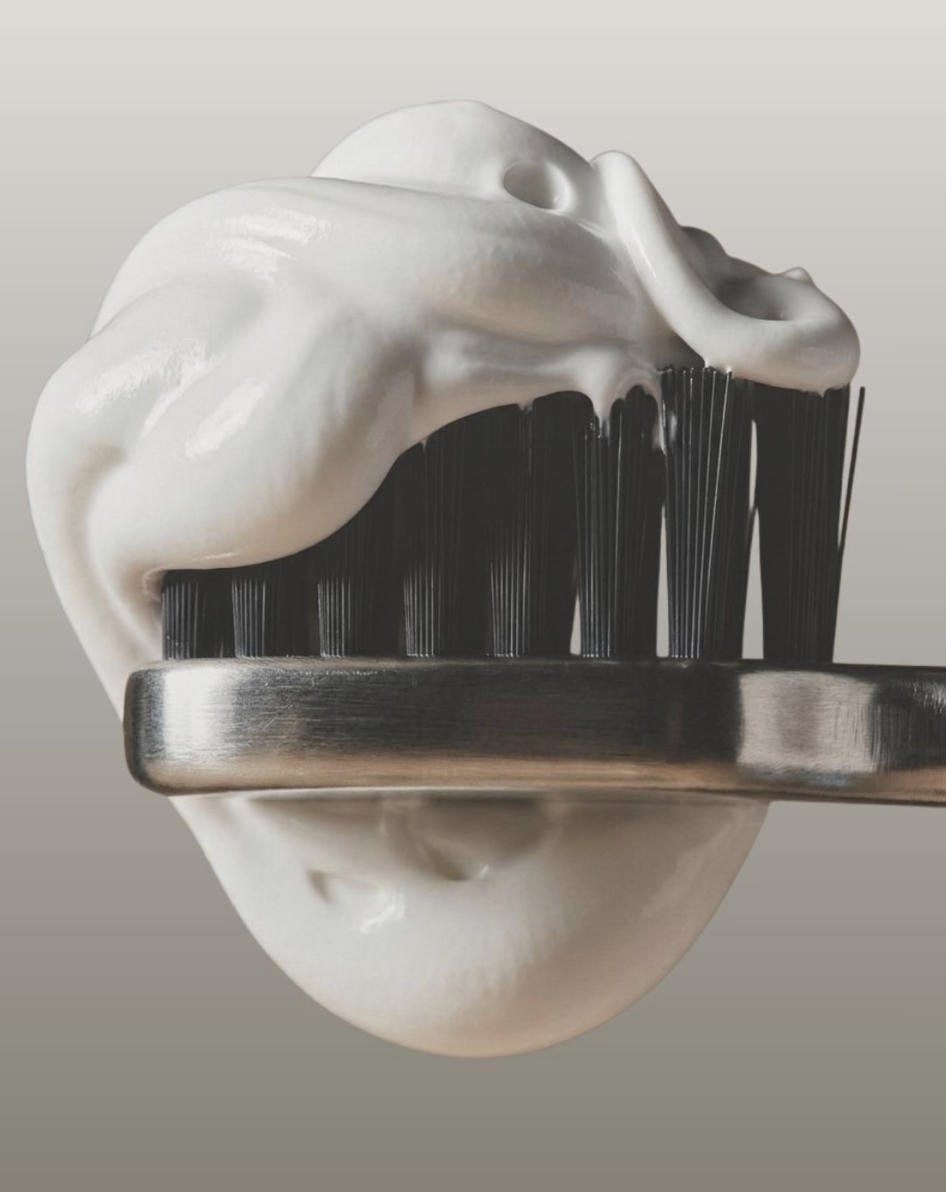
We're moving away from the sterile, clinical "clean girl" aesthetic. It's too flat. It doesn't account for the beautiful messiness of being human. Two ideas hold the whole thing together. The first is tactile luxury, the belief that the way a bottle feels in your hand should be as vital as the formula inside. The second is what I think of as the ancient modern, taking the fierce, protective spirit of our namesake and translating it into a minimalist, high-performance daily essential.

Okay, the question I actually wanted to ask. Walk me through your morning. The whole thing. And tell me, do you brush first thing or after coffee?
My morning ritual is something I'm constantly refining. It's where my ability to show up well actually begins. Now that spring is here, I open my blinds and my bedroom door as soon as the sun rises and let the morning light bake into my room. Sometimes I stay in bed a little longer doing affirmations and visualizations with my eyes open into the light.
When I get up, the first thing I do is scrape my tongue before heading downstairs for a big glass of mineral water with molecular hydrogen. Then I brush my teeth, typically outside on my balcony unless it's raining. After that I take a short walk around my neighborhood to wake my body up and get as much morning light as I can. Then breakfast, followed by a matcha. I take the matcha upstairs and sit in front of my red light and try to get some reading in before opening my emails, though that isn't always possible. Once the caffeine has settled and the light session is done, I waterfloss with baking soda, oil pull, floss, and brush again.
I know that's a lot. I'm an oral care girl.
Last one. What's the one thing most people get wrong about oral health?
That the mouth is separate from the rest of you. Most of us treat it as a thing to keep clean and presentable, sealed off from whatever's happening underneath. The whole premise of what I'm building is the opposite. Care in one place ripples through the whole system. The mouth isn't the exception to your wellness routine. It might be the most honest part of it.
Bastét French Mint Toothpaste is available at bastetritual.com.